
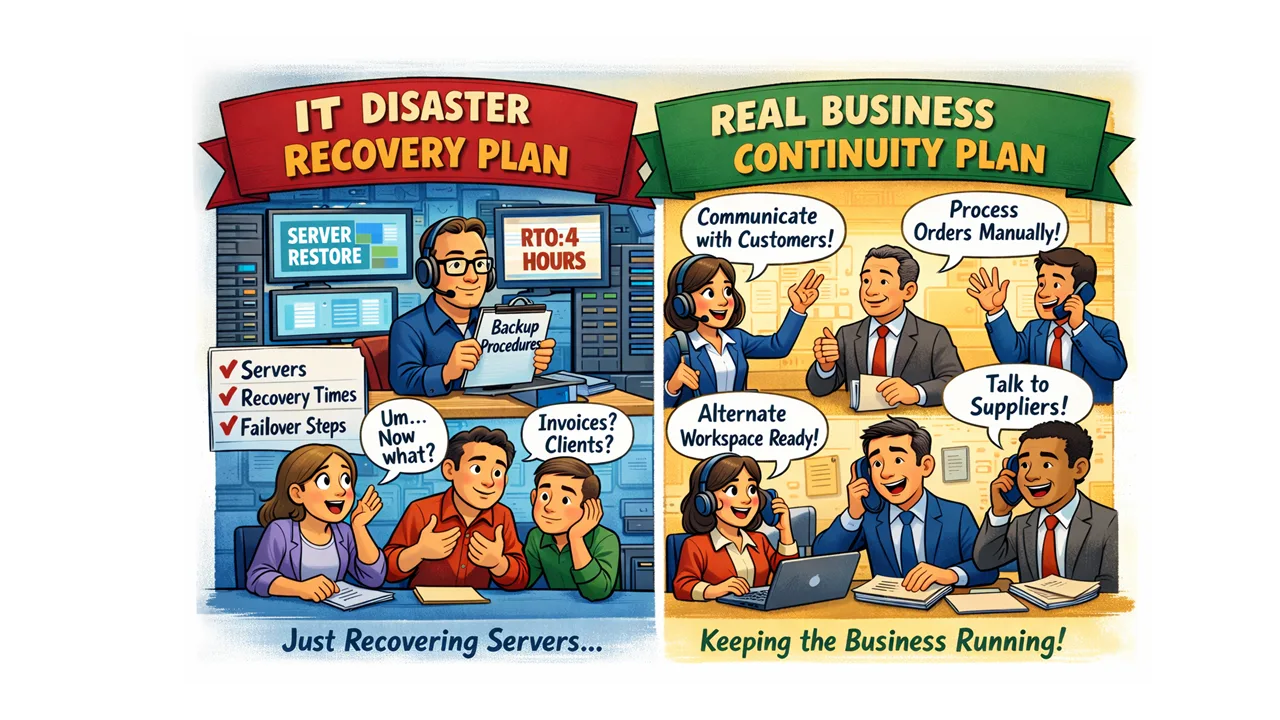
The "B" in BCP stands for Business. So why does your plan read like an IT manual?
Here is a test. Go find your organisation's Business Continuity Plan right now. Open it. Read the first five pages.
If what you find is servers, recovery time objectives, and failover procedures, I have uncomfortable news. That is not a Business Continuity Plan. It is an IT Disaster Recovery Plan with the wrong title on the cover.
I keep seeing the same scenario. Ransomware encrypts the ERP system. IT scrambles to restore servers. Meanwhile, nobody can invoice customers, pay suppliers, or tell the 200 clients calling in what is going on. The server is not the problem. The business is the problem.
ISO 22301 does not start with technology. It starts with understanding which activities keep the organisation alive, and how long each can be interrupted before damage becomes unacceptable. People, suppliers, facilities, communication channels. Technology is one input on a longer list.
So why does every BCP end up looking like a server inventory? Usually because the CIO inherited ownership. "It is about systems," someone decided. Nobody pushed back. The plan became a mirror of its owner: deeply technical, disconnected from how the business actually operates.
The Business Impact Analysis, if it exists, was a checkbox exercise. A spreadsheet sent to department heads asking them to rate applications by criticality. What came back was gut feeling, not real analysis.
And testing? A failover test that confirms a backup server starts is useful. But it tells you nothing about whether finance can process payments manually, or whether communications can issue a holding statement within 30 minutes.
Before you spend another euro on backup infrastructure, try this instead. Ask your leadership team who decides what when normal governance breaks down. Ask how you serve customers without your core platform. Ask whether procurement can function by phone for 72 hours. Ask who speaks to regulators in the first 60 minutes.
If the room goes quiet, your BCP is not ready. And the fix does not start with buying more technology. It starts with putting the word "Business" back where it belongs.
The organisations that survive the next crisis will not be the ones with the fastest failover. They will be the ones whose people and processes were ready long before the servers came back online.
What does the first page of your BCP actually look like?