Let’s be honest: for years, "digital sovereignty" felt like policy jargon something debated in Brussels corridors but rarely impacting our quarterly roadmaps. That era is officially over.
As we close 2025, the geopolitical reality has made sovereignty a hard operational constraint for every CISO, compliance officer, and board member in Europe. The Berlin Declaration, signed by all 27 Member States just last month, put it plainly: sovereignty is about our ability to "act autonomously and freely choose our own solutions" (Source: https://data.consilium.europa.eu/doc/document/ST-15781-2025-INIT/en/pdf).
But when you look at the actual data, the gap between that ambition and our operational reality is startling. We are building critical infrastructure on borrowed ground.
The "Dependency Trap": By the Numbers
We need to face the uncomfortable facts about our exposure:
Cloud Vulnerability: Despite years of "sovereign cloud" initiatives, 70-90% of Europe’s cloud market is still held by US hyperscalers. We are effectively renting the foundation of our digital economy (Source: https://www.clingendael.org/publication/netherlands-and-eu-prioritising-cloud-sovereignty).
The Silicon Gap: It is even starker in hardware. Europe produces less than 10% of the world's semiconductors, leaving us dangerously exposed to supply chain shocks (Source: https://ec.europa.eu/commission/presscorner/detail/en/ip_22_729.
Hardware Reliance: In 2022 alone, 38% of the EU's high-tech imports came from China, creating a supply chain dependency that is becoming a significant geopolitical liability (Source: https://www.reconnect-china.ugent.be/wp-content/uploads/2024/09/Reconnect-China_Policy-Brief-13_EUs-Technical-Dependencies-towards-China.pdf).
The Geopolitical Minefield: Risk is Now Systemic
For multinational corporations, this isn't just about "buying local." It is about surviving a fragmented legal landscape.
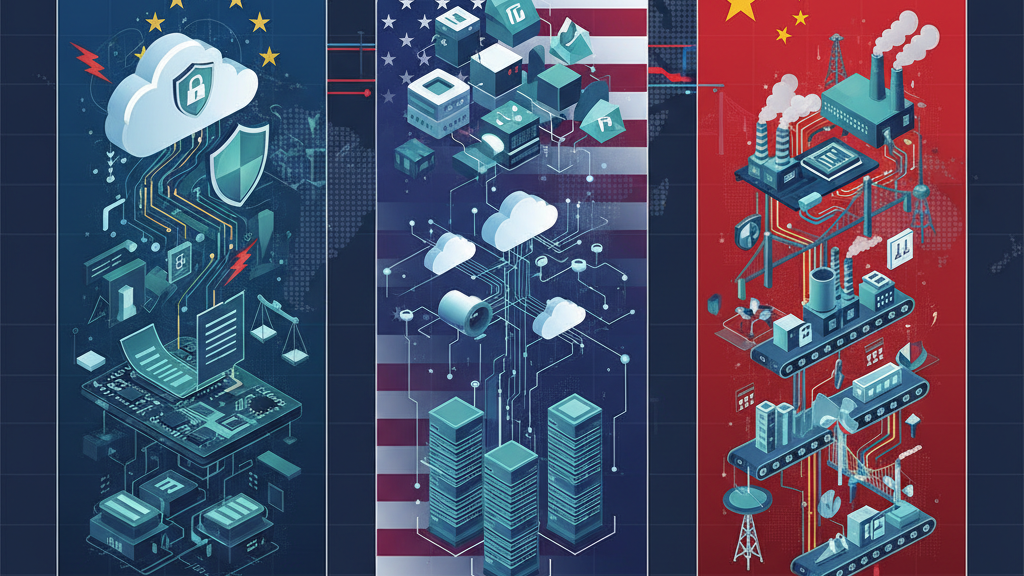
1. The Legal Tug-of-War (GDPR vs. The CLOUD Act) We are stuck in an impossible position. On one side, GDPR demands strict data protection. On the other, the US CLOUD Act allows American authorities to compel US-based tech companies to hand over data regardless of where the servers physically sit. This creates a direct, irreconcilable conflict with European privacy laws (Source: https://www.theregister.com/2025/12/22/europe_gets_serious_about_cutting/). "Data residency" is not the same as data sovereignty if the parent company is subject to extraterritorial laws.
2. The Espionage Threat The threat landscape has darkened. Intelligence agencies have identified state actors, particularly from China, Russia, and Iran as persistent threats in economic espionage (Source: https://www.dni.gov/files/NCSC/documents/news/20180724-economic-espionage-pub.pdf). We are seeing a surge in operations targeting intellectual property and managed service providers, turning our own supply chains into attack vectors.
3. The Cost of Decoupling This fragmentation has a price tag. IMF analysis suggests that technological decoupling could cost economies up to 5% of their GDP (Source: https://www.imf.org/-/media/files/publications/wp/2021/english/wpiea2021069-print-pdf.pdf).
Europe’s Counter-Offensive: Moving Money, Not Just Policy
The good news is that the EU is finally putting capital behind its strategy. We are moving from regulation to industrial policy:
Semiconductors: The European Chips Act is mobilizing €43 billion to double our market share to 20% by 2030 (Source: https://digital-strategy.ec.europa.eu/en/policies/european-chips-act).
AI Sovereignty: Perhaps most ambitious is the AI Continent Action Plan, aiming to mobilize €200 billion in public and private investment. This includes building "AI Gigafactories", massive computing centers equipped with ~100,000 chips each to ensure we aren't dependent on foreign models for our AI future (Source: https://www.csis.org/analysis/eu-ai-continent-action-plan).
The Innovation Reality Check
However, we can't regulate our way to innovation. Europe’s biggest Achilles' heel remains funding. Our tech scale-ups face a massive $375 billion growth-stage funding gap compared to the US (Source: https://www.stateofeuropeantech.com/reading-tracks/funding-gap-insights). Until we fix this, we will continue to see our best innovations (and the sovereignty they bring) migrate overseas.
Strategic Imperatives for 2026
If you are a C-level executive, "wait and see" is no longer a viable strategy. The market is already shifting, 62% of European organizations are actively seeking sovereign AI solutions, with highly regulated sectors like banking leading the charge (Source: https://newsroom.accenture.com/news/2025/europe-seeking-greater-ai-sovereignty-accenture-report-finds).
Here is my perspective on what needs to happen now:
Audit for Jurisdiction, Not Just Location: You need to map your dependencies. Knowing where your data sits is irrelevant if you don’t know which government has legal leverage over the provider.
Adopt Multi-Cloud as a Survival Skill: Relying on a single non-EU provider is a strategic risk. We need architectures that allow us to shift critical workloads to sovereign European clouds (like OVHcloud or others) if the geopolitical wind changes.
Open Source is Non-Negotiable: Transparency is the ultimate sovereignty. Open source offers the only path to true auditability and freedom from vendor lock-in.
Prepare for NIS2: The NIS2 Directive is forcing us to look deep into our supply chains. Use this compliance drive to root out risky dependencies (Source: https://digital-strategy.ec.europa.eu/en/policies/nis2-directive).
Sovereignty isn't about isolation; it's about having leverage. As we head into 2026, the question isn't whether you need a sovereignty strategy, it's whether you'll build one before a crisis forces you to.
How is your organization handling the tension between global efficiency and local autonomy? Let’s discuss in the comments.