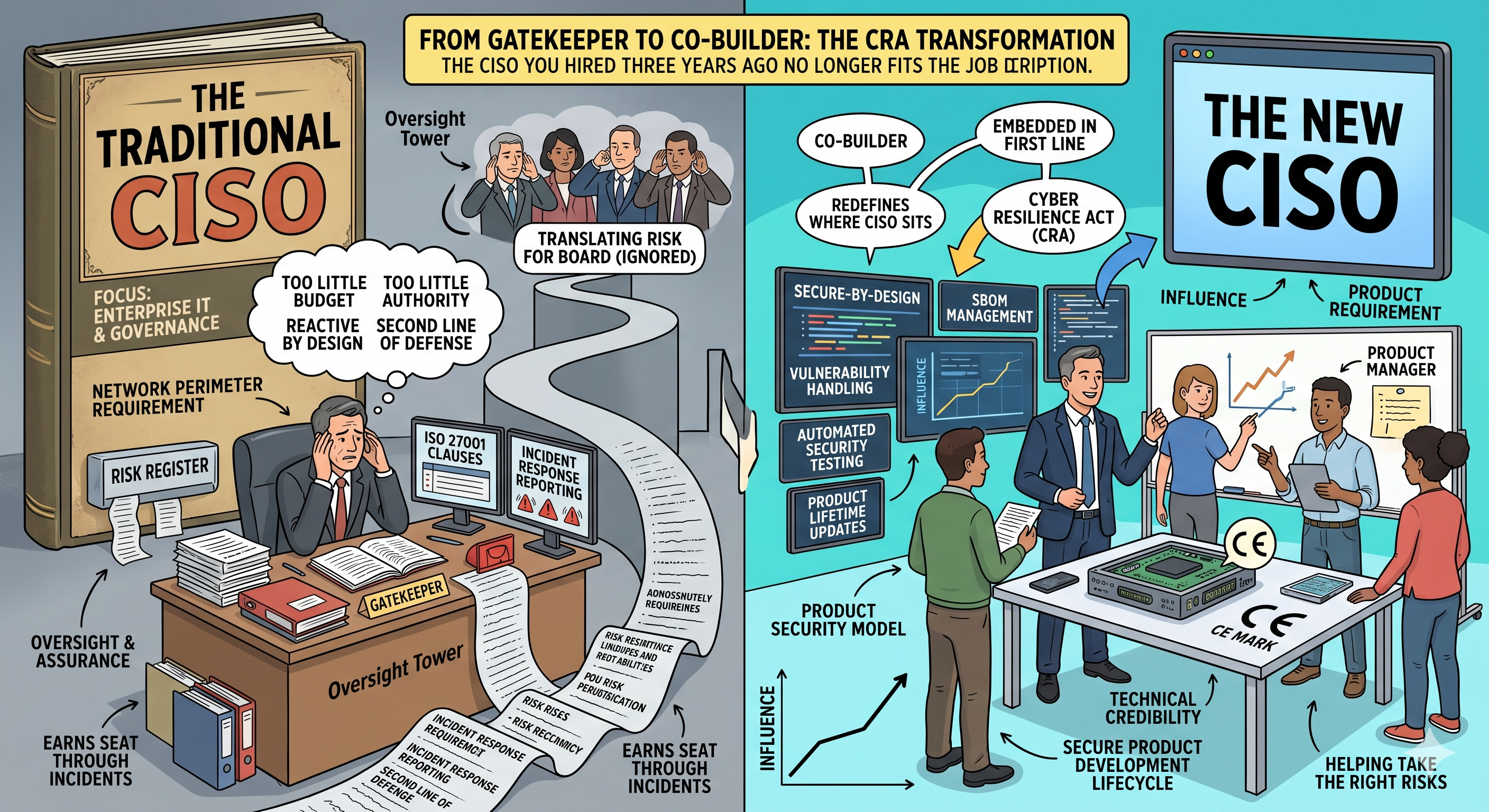
For two decades, the CISO has fought an uphill battle. Too little budget. Too little authority. A seat at the table that was earned through incidents rather than strategy.
The role was defined by its constraints: second line of defense, reactive by design, stuck translating technical risk into business language for boards that preferred not to hear the details. Risk registers grew longer. Threat landscapes grew wider. And the CISO was expected to manage both with resources that never quite matched the ambition written into the corporate risk appetite statement.
Then came NIS 2, DORA, and the AI Act. Each one added obligations, reporting timelines, and personal accountability for management bodies. CISOs barely had time to digest these before the Cyber Resilience Act arrived and changed the question entirely.
Because the CRA does not ask whether your organisation manages cyber risk well. It asks whether your products were built securely in the first place.
That is a question most CISOs were never structurally positioned to answer.
The CRA changes what security means in an organisation
The Cyber Resilience Act, which entered into force in late 2024 with obligations phasing in through 2027, does something no previous European regulation has done with this level of specificity: it makes cybersecurity a product requirement.
Not a corporate governance requirement. Not a network perimeter requirement. A product requirement. Enforced through CE marking. With direct obligations on manufacturers and importers of products with digital elements.
Compare that to NIS 2, which speaks to the organisation's risk management practices and incident reporting. Or to GDPR, which focuses on personal data processing. The CRA reaches directly into how products are designed, developed, maintained, and retired. It demands vulnerability handling processes, security updates for the expected product lifetime, and secure-by-default configurations. It requires manufacturers to document and demonstrate that cybersecurity was considered from the earliest design phase.
From the earliest design phase.
Now ask yourself honestly: in your organisation, who is present at the earliest design phase of a new product? Product managers. Engineers. Architects. UX designers. Perhaps a CTO.
The CISO? Rarely. The security team? Almost never, until someone schedules a penetration test six weeks before launch.
The second line of defense is a dead end
The traditional three lines of defense model placed the CISO and the security function firmly in the second line: oversight, policy, assurance. The first line, the business and engineering teams, was supposed to "own" the risk. The second line existed to challenge, advise, and report.
In practice, this meant the CISO learned about product security decisions after they were made. Risk assessments happened on finished architectures. Threat models, when they existed at all, lived in documents disconnected from sprint backlogs. The security team operated as an internal auditor with a fancier title.
The CRA makes this model untenable. When a regulation requires you to prove that security was embedded throughout the product development lifecycle, a CISO who only reviews outputs is not compliance. It is evidence of a structural gap.
From gatekeeper to co-builder
Here is the uncomfortable truth that many CISOs have not yet confronted: the CRA does not just add new items to the compliance checklist. It redefines where the CISO must sit in the organisation.
If your products must be secure by design, someone with security authority needs to be in the room when design decisions are made. Not reviewing them afterwards. Not signing off on a risk acceptance form three sprints later. In the room. With the engineers. Arguing about the trade-offs between performance and encryption, between user convenience and authentication strength, between time-to-market and vulnerability remediation.
This is not a second line of defense job. This is a first line, business-embedded function.
The CISO of 2027 needs to understand product roadmaps, technical debt, CI/CD pipelines, and software supply chains with the same fluency they currently bring to ISO 27001 clauses and risk registers. That is a significant shift in competency profile, and very few organisations have acknowledged it yet.
Some will argue this compromises independence. I would argue that independence without influence has been the CISO's real problem for years. You cannot meaningfully govern product security from a position where you are structurally excluded from product decisions. That is not independence. That is irrelevance with a compliance label.
What actually needs to change
This is not about giving the CISO a new reporting line and calling it transformation. Several things need to shift at once.
The CISO must develop genuine technical credibility with engineering teams. Policies and frameworks alone will not earn a seat at the product table. Understanding secure development practices, SBOM management, and automated security testing is no longer optional knowledge. It is table stakes.
Organisations must restructure security governance so that product security stops being an afterthought bolted onto enterprise risk management. The CRA demands a product-centric security model, and the governance structure must reflect that reality.
Boards need to understand that the CISO's mandate has expanded. The budget conversation is no longer just about firewalls and SOC analysts. It now includes secure development tooling, security engineering headcount embedded in product teams, and ongoing vulnerability management across every product in the portfolio.
And perhaps most importantly, the CISO must embrace a fundamentally different relationship with risk. In the second line model, the job was to identify and report risk. In the product security model, the job is to help the business take the right risks, at the right time, with the right mitigations built in from day one. That requires judgment, not just methodology.
The CISOs who will thrive
The CRA is not the only force pushing this transformation. The AI Act introduces similar expectations for high-risk AI systems. DORA demands resilience testing integrated into financial product lifecycles. The direction of European regulation is unmistakable: security is becoming a product attribute, not just a corporate function.
The CISOs who will thrive in this environment are the ones who stop defining themselves by the controls they enforce and start defining themselves by the products they help build securely. The ones who trade the comfort of the oversight role for the messiness and influence of being embedded in the business.
The ones who refuse to make this shift will find themselves managing an increasingly irrelevant function, writing reports about risks they were never in a position to prevent.
The CRA did not create this problem. It simply made it impossible to ignore.
Where does your CISO sit today: in the oversight tower, or in the product trenches? I would be curious to hear how your organisation is adapting.